Overcoming Growth Challenges: Empowering Leadership for a Sustainable Future
When a Northern Canadian architecture firm nearly tripled in size within five years, the growth that defined its success became the source of its greatest vulnerabilities. Innovia Partners identified a self-reinforcing cycle of over-expansion, eroding profitability, and leadership bottleneck, and restructured governance to give the next generation of leaders the clarity and accountability to carry the firm forward.
- Practice
- A rapidly growing architecture firm serving remote Indigenous communities in Canada's North
- Engagement
- 4 months
- Disciplines
- Governance & CultureTalent ManagementDesign Excellence & InnovationOperational EfficiencyBusiness Development & Pursuits
Our client, a forward-thinking architecture firm, has built a strong reputation for its vibrant, collaborative culture and commitment to local Indigenous communities, quickly becoming one of the most respected workplaces in Canada's North.
In just five years, our client's focus on delivering resilient building solutions for remote and challenging climates drove rapid growth, nearly tripling both revenue and headcount. This expansion included entering new locations and creating dedicated Electrical and Mechanical Engineering divisions, all aimed at better serving their communities.
While these successes were certainly worth celebrating, new challenges began to surface. Shortly after we began our engagement and started conversations with the team, one staff member remarked, "The owner's relentless pursuit of new projects seems driven by a deep anxiety about ensuring there's enough work to sustain the business."
This insight raised a red flag and led us to identify that the firm had fallen into what we term a "growth trap."
What stood in the way.
The growth trap creates a snowball effect that is financially draining and exhausting for the team. As the volume of new projects increases, the need to hire more staff becomes urgent. However, without effective onboarding and training systems in place, productivity suffers, and projects become less profitable.
To cover rising operational costs and stabilize cash flow, the firm is compelled to take on even more projects. Lacking the time and processes to strategically pursue high-margin work, they often end up with numerous low-margin, smaller jobs that barely break even. This leaves the staff feeling overworked and demoralized while profitability continues to decline. The cycle perpetuates itself: taking on new work, hiring additional staff, watching costs rise, and then seeking more projects to make ends meet, ultimately pushing the team to its breaking point.
As one associate remarked, "Some of these smaller projects don't really make money. They end up costing us a lot of time and effort. Why do we keep going after them?"

The “Growth Trap” sparked fears for the firm’s future
As the firm struggled to break free from this vicious cycle, the strain on staff intensified with the departure of one of their most talented senior associates. This raised concerns about the impact of ongoing turnover, leading to declining morale, and growing anxiety among leaders about the firm's future and its capacity to sustain its legacy over time.
The growth trap, though less immediately apparent, was at the root of several other critical challenges the firm faced. Overburdened by the demands of delivering multiple projects, leaders had neither the time nor the motivation to tackle broader firm-level issues. These included a
- Lack of a clear strategy for hiring and retention in an exceptionally challenging recruitment environment
Hiring in the remote Canadian North is diIicult due to a limited local talent pool. Finding candidates from other provinces who meet their specific needs (such as long-term commitment, a willingness to engage in outdoor activities and remote living, a dedication to sustainable design, and respect for Indigenous communities) proves dificult. Attracting the right individuals is essential because misalignment leads to high turnover, disrupting relationships with Indigenous clients (who value trust and continuity) and undermining the firm’s culture, while also creating ineIiciencies and knowledge gaps from shifting project teams.
- Leadership bottleneck with no one stepping up
Last but not least, nearly all decisions rested on the owner's shoulders. While associates were implicitly expected to take initiative, the owner was often seen as the ultimate authority. This absence of formally defined accountabilities discouraged associates from "taking the lead", resulting in important and controversial issues being postponed or left unresolved.
The combination of these challenges underlined the need for structural and cultural shifts to break free from the growth trap and secure the firm’s future.
Sustainable growth requires structure, but it doesn't mean sacrificing culture or quality.
How we worked alongside the practice.
With a methodology rooted on deeply understanding creative businesses from a people-centered perspective, we carried out a comprehensive assessment to uncover the firm's financial and operational pain points, along with hidden challenges within the Employee Lifecycle.
Using firm-wide surveys and targeted interviews, we explored critical questions such as:
- How talent is attracted, developed, and retained?
- How knowledge is cross-pollinated across teams?
- How decisions are made at both the project and firm levels?
- Are roles are aligned with the right people and well-defined expectations?
- How performance and incentives are managed?
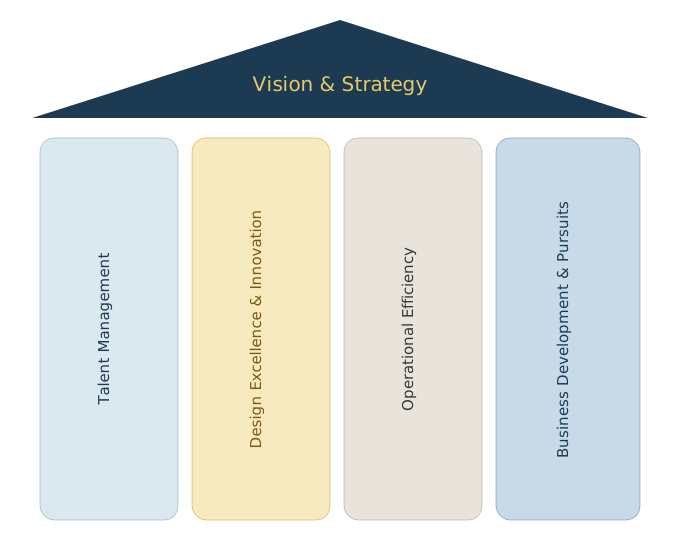
The insights gathered highlighted a critical focus area for our recommendations: structuring governance around four strategic practice pillars — Talent Management, Design Excellence, Operational Efficiency, and Business Development. This involves clarifying roles and establishing well-defined accountabilities.
By assigning each associate to lead one of these pillars, we aimed to distribute decision-making responsibility across the leadership team, empowering them to take ownership of crucial strategic areas. For instance, one associate could develop a more structured approach to project selection and proposal creation, while another would shape the talent acquisition and development strategy, ensuring that onboarding and performance evaluations genuinely reflect the needs and voices of junior talent. Additionally, another associate could spearhead the firm-wide implementation of project templates and digital assets to ensure design consistency and create operational efficiencies.
However, simply assigning each associate to lead one of the four strategic pillars isn't enough. To ensure the success of this governance model, effective change management is crucial. This involves clear communication, training, and widespread buy-in across the firm. It's about ensuring everyone understands how these pillars influence their daily roles and professional growth, while also being equipped with the tools they need to succeed.
In our work, we find that new associates and leaders with increased responsibilities benefit from establishing a consistent cadence within each pillar to ensure progress and accountability. This approach promotes traction, focus, transparency, and agility, enabling the firm to collaborate effectively as it grows.
What changed for the firm.
This new governance model strengthens the company's collaborative culture while enhancing decision-making and progress without over-relying on the owner. By defining clear and meaningful roles, the firm not only paves the way for a smooth succession process but also empowers the next generation of leaders to uphold the organization's legacy while building its future. If you’re facing similar growth challenges, preparing for succession, or looking to empower your leadership team, let’s connect to discuss how we can help you turn struggles into long-term success.
Measured outcomes from the engagement.
Related work and writing.
Have a similar challenge? Let's talk.
Every engagement is shaped by the firm and the moment. If anything in this story resonates with where your practice sits today, a conversation is the best place to start.